Harold Golden came to his calling as violin maker and repairer by first building a kit guitar as a teenager. He then discovered he had a talent for fixing friends’ guitars. He apprenticed with master violin makers Sofian Zapf and Ed Campbell and then with the acclaimed Simone Fernando Sacconi.[i]
Golden traded one of his own Golden designed violins for a 1930 violin made by the German violin maker Peter Harlon . Harlon, who served in the Nazi Luftwaffe, was dispatched to make violins in a castle during the war and famously refused orders to destroy everything when the Allies approached at the end of the war.[ii]
Harold Golden created a violin based on a Renaissance violin which incorporates the golden proportions including the scrolling at the top. When played at a high end shop in Philadelphia, the Golden violin compared favorably with a $120,000 Italian violin.[iii]
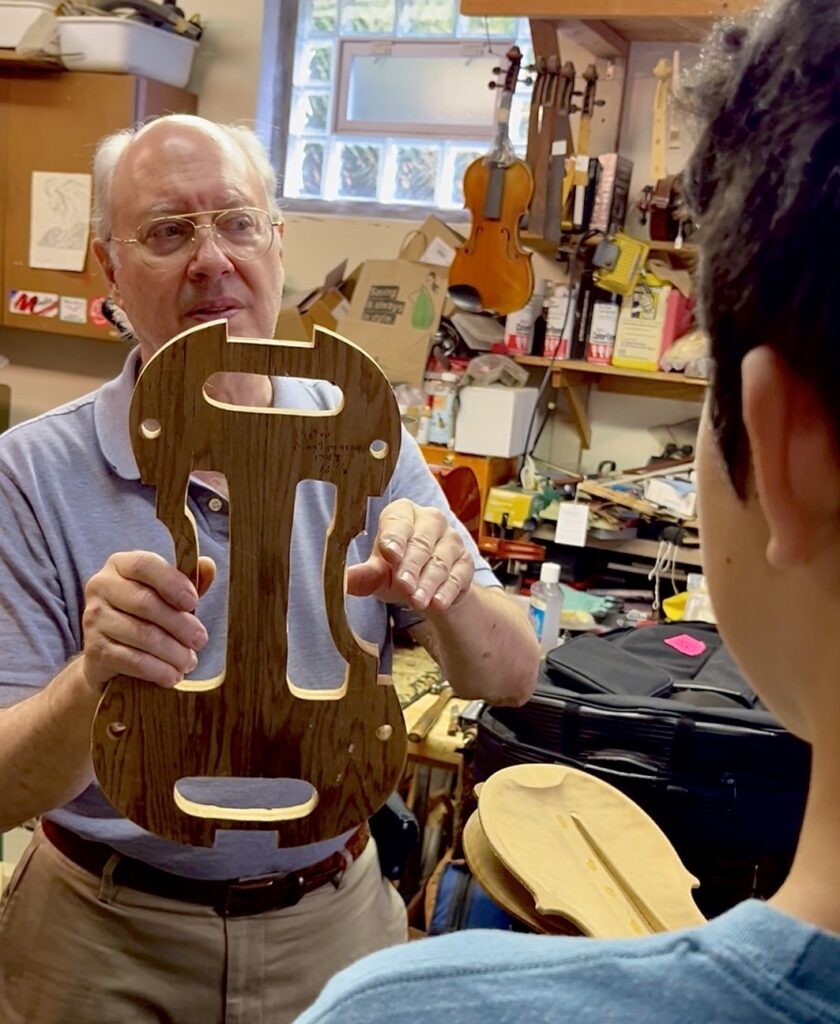
One day Golden was watching a friend repair a trumpet and asked him if he had an extra bell. They proceeded to make a trumpolin, also known as a Stroh fiddle, that uses the bell to amplify the string bowing. Golden says songs have been written for the instrument and there’s even been an orchestra. [iv] When we came to pick up a repaired violin,Golden graciously gave a tour of his studio full of specialized tools, violins and other stringed instruments in various stages of repair and reconstruction Golden kindly gave a tour of his studio
[i] Here’s your old strings. You can put them in the box. The old string box. Yeah. As far as me, uh, I really didn’t get into this. It got into me. Really? Yeah. It called me one day and said, “You’re going to fix violence.” I said, “All right.” When did you receive the call? How old? When I was a teenager. When you’re a teenager. Do you hear such a call yet? I think he [laughter] Yeah, you got to get called for things, man. You know, first I just started doing things on my own. Um, I built a kit guitar and then I started repairing my friends guitars when they break. I was for some reason I could figure out a way to fix them and then uh then I apprenticed, you know, but you know, I started reading books and making things on my own and then I apprenticed in a violin shop which uh I think there’s a picture here. Yep. Up here. And that was my my teacher Sofian Zapf. And that’s him in the repair shop there. Oh. And then it went from there, you know, I went to uh I studied with somebody who learned violin making with a very famous man named Sacconi in New York. And then I went to Arizona for summers and studied with Ed Campbell. And uh oh, and I won that award at the Violin Makers Association of Arizona in 2008.
[ii] That’s pearl inlay. That’s just perfling. I’m going to repeat that. It’s Peter Harlon. So Peter Harland. Now he made this in 1930. Okay. But uh during the war he was in the Luftwaffa and the vi the government decided well you’re a violin maker. Why don’t you open us a violin making school in this castle? We’ll give you this castle in Germany. So he did and he had a violin making school there. And of course the Americans were winning. So the Germans were destroying everything and running and uh the government said destroy the castle. So what do you think he did? He gave up to the Americans and he did not destroy it. Is that cool? So that’s why he’s my hero. He was smart enough to realize the German government did not know what they’re doing. They were just destructive. He didn’t face consequences for Well, the government was gone, man. America just took over. He gave up to the Americans. And how did you come? The Americans treated them well. They they didn’t treat him like their own government. How did you come into possession of it? I came into the possession of this because I have a man who, by the way, is coming in today. He brings me instruments to fix and bows to repair and then he sells them. He’s, you know, he’s that kind of a guy. He just goes around getting things. And he showed up with that one day. So, I gave him one of my handmade violins to trade for it. Wow. It’s strung like a five string violin with a low C string. It just played exactly like like a five string violin. Doesn’t have the the greatest sound, but it’s fine, you know. And you’ve got that that C [music]
So you got the viola and you got the violin, but like I said, it’s not going to give you one of my violas. So you can hear the differences. [music]
See, that’s a viola. That’s still a violin. Well, actually, that’s not even a violin. That’s a vo.
This guy is a golden violin. Now, this one I I drew the outline using a Renaissance design. I used um graph graphs and I did the curves using these graphs and these mathematical things that that follow the golden rule and then really and I came up with this. The golden proportions. Yeah. The golden proportions. Oh my gosh. Yeah. Yeah. Yeah. Yeah. So the golden proportions have a lot to do with this you know like even the scroll comes from that that Renaissance thinking. So if you look at Renaissance paintings and you see the structures and there are scrolls at the top of the uh pillars those scrolls are based on this formula where it just comes out like that. It’s really the golden ratio spiral. Yeah it’s pretty cool here. [music]
[music]
Yeah, sorry I can’t play better today. Today’s one of my shaky days. Oh, but there you go. And what made you think you could improve on Stratavarius and Guu? I didn’t think I could improve more. I just I just went on a a journey to try. Have people tried this and and reviewed it or I have a couple good good players have my my violins out. Oh wow. But let me tell you my my one of my favorite things was I took uh three of my violins downtown to the very fancy high end shop and I said give me one of your best Italian violins and we recorded it and we played my violins up against $120,000 Italian and mine were just as good. Is that cool? Yeah, it’s cool. Oh, so that was
[iv] A trumpolin. In case you’re having trouble hitting the high notes on your trumpet, you’ll have no trouble hitting the high notes with that trumpet. Oh my gosh. Can you demonstrate that? Oh, now you’re asking too much. I’ll try. All right, let’s see if I can do anything with this. And what’s the story about that? The story about that is I was sitting in the shop one day watching my friend repair a trumpet while I was repairing a violin and I said, “Hey, you got an extra bell?” And we made this I can hit the high C’s. I think I can. Now, has any composer written a piece just for the trumpolin? I think there you there was something called the stro-fiddle and from what I understand they actually had a whole orchestra of Stroh fiddles I guess late 1800s so I’m sure somebody wrote for Stroh fiddle orchestra I’m sure they did What’s a Stroh fiddle? A Stroh fiddle is basically, not a trumpet bell but it’s the, you know, the bell that the original photograph machines you know – my my master’s voice that Bell. Let me see if I have a picture for you. Is this you at the violin there? That’s Jascha Heifetz . Oh. And that’s my cousin’s pianist. He accompanied Jascha Heifetz during World War II. Oh my gosh. And that’s the only picture of Jascha Heifetz in uniform playing for the troops overseas Awesome. Oh my. Here’s a Stroh bass. So, I Iplayed a Stroh fiddle at a folk festival one time. It was really cool. So, it’s the same concept but a little better design. There’s, you know, something I couldn’t do to figure out. Wow. But it’s pretty cool.