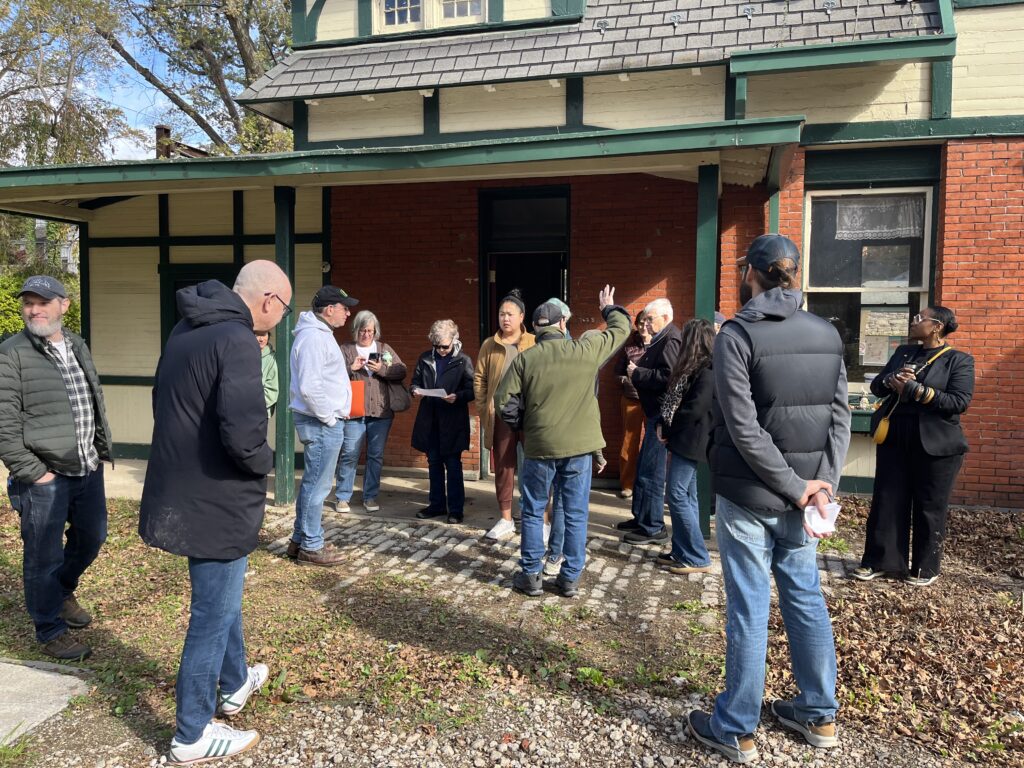
On November 1, 2025, developer Ken Weinstein hosted open houses of five dilapidated train stations along the SEPTA (Southeastern Pennsylvania Transportation Authority) regional Chestnut Hill rail lines in Philadelphia. Through his company, Philly Office Retail he has undertaken to renovate them. “Bring your ideas. All are welcome!” a flyer announces. The buildings once housed ticket offices but are now vacant and have fallen into substantial disrepair.
Your correspondent hopscotched around the stations and shares with you videos of these five, once busy, now run-down historic structures. In the videos, the developers and members of the community talk about what they know and what their hopes are for restoring these historic buildings so they can be a rejuvenating force in the neighborhood.
In a competitive bidding process culminating within the last year or so, Weinstein’s company was awarded long-term leases with SEPTA,
Weinstein plans to sub-lease four of the stations for apartment use on the second floor and commercial use on the first. These are Tulpehocken, Upsal, Mt. Airy, and Carpenter Lane. The fifth, Gravers, is thought to be more suited for a single family rental. The successful and popular High Point Café at Weinstein’s Richard Allen Lain train station is a model for how the other stations might see new life.
See Hidden City’s excellent article on the stations here.
See Close Up interview with Weinstein below
TULPEHOCKEN station has visitors enthused about potential uses.
An excited gaggle of people explored the gutted Tulpehocken station, the first of the stations on the open house schedule. “We obviously want something that serves the neighborhood. In many cases, this is the only commercial space that zoning will allow to be in the area” said Evan Thalheimer of Philly Office Retail. He pointed out the successful High Point Café at the Richard Allen Station as a proof of concept. A yoga or dance studio one woman going through envisioned and her partner- a gym!
Upsal station could house a coffee shop again.
Evan Thalheim er of Philly Office Retail says the Upsal Station, one of the five train stations slated for renovation, had been used for a studio upstairs and a café downstairs. One gentleman going through the building said he was scouting it out for his sister, a recently licensed psychologist who is also interested in starting a coffee shop. Upstairs, your correspondent met Harry Garforth who used to work for SEPTA and authored “Frankford’s Elevated Railway and its Predecessors.” According to Garforth , the trains were originally operated by the Pennsylvania railroad. The stations were originally one story but then second floors were built so to house the the station master. These handled buildings bills of lading and such and provided a more secure presence at the station. The stations handled freight, such as coal.
Outside the station your correspondent connected with Sandy Smith, former home and real estate editor for Philadelphia Magazine, who had just toured the station. Smith goes by @marketstel13 on Instagram.
MT AIRY station, in a prior reuse, housed a much loved bookstore and coffee and muffin stop for commuters
I have a special affection for this station. I lived on the same street, Devon Street, directly opposite the station for two years. Some years later I returned to the area and lived directly opposite the station but on the other side of the tracks on Sprague Street. I recall running to and sometimes missing the train because I rarely budgeted my time for the three minutes to cross the bridge and walk down to the tracks.
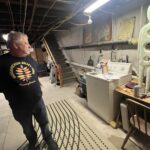
And then, years later, I would spend wonderful times browsing the cramped maze of bookshelves in Greg Williams’ much beloved bookstore, Walk A Crooked Mile Books. As a former used bookstore owner, I treasured this store for its lovingly and finely curated collection. For a time, I volunteered sorting overstock books, albeit with a touch of trepidation, the low ceilinged, damp, fan ventilated, stringed lightbulb lit, treacherously navigated, book filled cave of a basement.
As on other train station tours, your correspondent learned interesting facts from others going through the buildings. One such person offered that architecturally, the roof shape intentionally mimicked coal chutes. (Coal was originally transported along these lines)
Gone now are the books but not the spirit of the store. Williams had also catered to commuters with hot coffee and muffins.
And Williams hosted outdoor concerts and flea markets just outside the building. In response to a question, Weinstein acknowledged that this low-lying area might be prone to flooding and that the issue would have to be addressed in the renovation process.
GRAVERS station was a residence until recent years but an art gallery could potentially occupy first floor.
I was eager to tour Gravers Station. It is a couple blocks from home, so it is where I take the regional rail into town. It is very visible from Gravers Lane and I often walk by it on the way to the Water Tower or rec center’s field. For the last thirty-ish years at least it has not served as a ticket office and for perhaps fifteen years has been uninhabited. Even when it was occupied, curiously, I never encountered anyone entering or leaving.
The residential part has ample space, and the claw-tooth tub speaks to its age as does the wall-to-wall carpeting and squishy floors. The handsome, stuck in time, station space has a cozy ticket office and some folks posed for photos in front of it.
The whole of the property will likely be renovated as a single-family residence although Philly Office Retail is open to proposals for an art gallery on the first floor.
CARPENTER station might fit a cafe like the Richard Allen Station because its layout is similar.
“The historic [Carpenter Lane] station building has been listed in the Philadelphia Register of Historic Places since August 6, 1981.It is in zone 2 on the Chestnut Hill West Line, on former Pennsylvania Railroad tracks, and is 9.8 track miles from Suburban Station. In fiscal 2012, this station saw 371 boardings on an average weekday.” From Wikipedia.
The residential part of the building has sagging floors and try there’s debris about. But the adjoining ticket office is in good condition with shiny floors, even though tickets are no longer sold there.
The layout of the building is similar to the one at Richard Allen Lane station, says Evan Thalheimer of Philly Office Retail, so could accommodate a café below and a residence above like Allen Lane.

Transcript of CLOSE UP interview with Ken Weinstein
KW=Ken Weinstein
CU= Close Up
KW:So there’s five train stations. Today was a a walkthrough for neighbors and people interested maybe in renting.
CU: So what’s the timeline for next steps?
KW: So, architects are starting this week, 3D mapping and drawing the floor plans and we will have schematics designed by the end of the year which we will then present to SEPTA for their approval. We will then proceed with construction docs and permits and historic tax credit approval and then hopefully begin construction middle of 2026. About 12 months of construction. So, we’ll finish middle of 2027…We didn’t uh actually realize how big of a size difference there wasin the station and therefore we didn’t realize how big the layouts were different until we started looking at SEPTA’s square footage numbers and estimating what the first floor was.
CU: And when did you first start to get involved with the stations?
KW: It’s been a while now. We’re talking more than 15 years when it actually started here at Carpenter Lane station. West Mount Airy neighbors put out a survey to see whether the neighbors would accept not having a ticket office and a waiting room in exchange for the reuse of the building because it would be hard to redo this if SEPTA was retaining the ticket office and the waiting room. So that sort of started the ball rolling and the ball kept rolling for 15 years until SEPTA put it out to bid about a year ago.
CU: Okay. And for people accustomed to like taking shelter in the station in bad weather is there going to be-
KW: We’re hopeful that we find a user like a food user. Where people just as they do with High Point Cafe at the Richard Allen station can find shelter on days that it’s very cold.
CU: Excellent. That’s very exciting.
KW:Yeah. Yeah.
CU: Good luck with it.
KW: Thank you.